I seem to surround myself with indirect people. This is amusing since I can be so aggressively direct that I often insult people. While tact is something I've learned over the years (especially since I've been married), I still expect people to tell me what they want. I don't know about you, but being asked if I want to take out the garbage 10 times in a row doesn't make me want to do it... in fact, it makes me more likely NOT to do it.
My favorite, though, is when someone proposes an activity or game plan, but starts it with "well, do you want to..." instead of saying "hey, I'd really like it if..."
With indirect people, half the time you have no clue what they really want because they're too frightened to actually come out an tell you. And then later when they're feeling picked on and ignored, it's you that gets in trouble for not listening to what they really want.
While women or more commonly guilty of this, many men do it as well.
So what is the answer? Obviously being literal doesn’t help, because the indirect people are aggressive enough to continue to ask the same question over and over until you get the point. So, I'm thinking that once again duct tape may be the answer.
Sunday, May 28, 2006
Indirectly Getting to the Point


Saturday, May 20, 2006
DNA and the God of Thunder
It seems that throughout human history, cultures have a tendency of creating a multitude of Gods to represent the different things around them. The most popular have lasted until our day, with heroes such as Thor and Hercules still popping up in media today. While people often laugh at this concept, it's actually a very understandable and still very common human practice.
The truth is that everyone wants to understand the world around them. So, in a world where science consisted of magic and religious believe, different Gods were assigned to each natural event. Soon a whole pantheon was established; with each God requiring different forms of worship (in that way man believed they could control the world around them). Once again, very common behavior.
Today most people look back at the ancient cultures and shake their heads, wondering how the Greeks or the Norse could believe in such inventive stories. The more dominant religions today focus on one God, and most of those tolerate science, with some embracing it and other rejecting it outright. The funny thing is, we STILL do this today. Instead of assigning Gods to different natural, unnatural or unsettling events, we assign scientific explanations. In many ways, Science has become the new pagan religion of our day.
Instead of a God of thunder such as Thor or Zeus, we have weather systems- equally mysterious and unpredictable. This weather system even has a following of priest, or Oracles, who tell us what we can expect from the almighty weather system from day to day.
Instead of a God of love, we have the Hormone, a powerful creature that attacks us in groups and forces us to fall in love with random strangers. Only when we've satisfied the mad lust that we were made to feel against our will does the hormone leave us alone... at least for awhile.
Instead of a God of war we have politics, with politicians its priests.
Instead of a God of evil, hate, or trouble, we have DNA... DNA is the scariest of all, for like Zeus of old we never know when or who DNA might strike, or how it will change or affect the poor victim.
The Gods of old did more than just put a name or face on the things that were feared, they took responsibility for those things that people refused to. If a man was a rapist and a murder in the old days, it would be said that the god of war, or the God of love, or a trickster god had influenced the man and made him commit those crimes. Today, we blame it on bad parenting, mental illness and behavior that may have been passed on genetically.
We embrace these new scientific discoveries and theories just as much, if not more, than the ancient Greeks embraced their pantheon of Gods. In the end, people just need somebody to blame.
Afterward-
Now, I want to explain something before anyone takes offense. I do believe that there are something beyond our control, I do believe that mental disorders, handicaps, and behaviors can affect people and that these thing could be inherited. but I also believe that there are some who, instead of being a responsible adult and working on their issues, use that trial as an excuse to do nothing but complain about how unfair the world is.
Monday, May 08, 2006
In the army now
And so, I don't really have a political stance. I think some things are wrong while others are right. One thing I have always been against is war. Personally I don't think the best way to bring someone to your way of thinking involves violence (unless it involves Napoleon dynamite fans, but that's another story). This could be because I'm not a violent person, well, not normally, anyway.
A big source of contention between my father and I while growing up was my refusal to join the army. While I'm not sure what his point was, exactly, he always got angry when I would refuse to even consider joining the army. Who knows, maybe it would have been good for me. Personally, I don't think I would survive the army or military... I'm just not that type of guy (I break under pressure when pressure is defined and mean military men shouting at me..... Come to think of it I was never a fan of GI Joe either....). While I think my Dad thought I was condemning the military, I wasn't; it just wasn't for me.
I always support the men and women to protect our country. It's the political leaders and decisions that direct the military that bothers me. I don't think we always have the best reasons to go to war, nor do I think war is always our best option.
I have several brothers, four of which I grew up with. Two are currently in the armed forces, with a third to join here very soon. Our father was also in the military. I think the military is an honorable profession, as I said before, but it disturbs me that I know nothing about the politics that will ultimately decide my brother's fate. How sad would it be if, on the day of my brother's funeral, I was unable to explain to my child or nephew why their uncle or father wasn't coming home, or what he died for? I don't want to know about politics, and I think war and the reasons why we fight are childish. Apparently my brothers don't (or they also don't care and figure it's a paycheck... Who knows). I think I owe it to them to find out just what they are fighting for.
I don't agree with war, but I suppose it's a little more productive than fast food (although I do believe that the cheeseburger could be credited for several inventions... But that's another story).
Wednesday, May 03, 2006
The Passion of the Ignorant

For those you may not know, I'm a member of The Church of Jesus Christ of Latter Day Saints. As such, I'm fairly conservative while being open to new ideas and approaches. At least, that's how it's supposed to work. Unfortunately, during my time in the "Mormon corridor" I've run across nothing but bias and close mindedness. While there is occasionally a cool person every now and then, for the most part the people here piss me off. I think my first push towards that direction came when someone, upon learning that I was from Maine, said "oh, it must be nice to be out here (Utah-Idaho) where the church is so much stronger." When I answered "no, the church may be smaller, but it's just as strong as Utah," I was given a knowing wink before the subject was changed.
Personally I'm of the philosophy that size has nothing to do with strength. Those familiar with the bible may remember a story or two about that. I've found that those members that live in areas where the church may be smaller are actually stronger in their faith because they have to make a more conscience decision to live the gospel.
A great reflection of this is sacrament meeting, especially fast and testimony meetings. It seems that many have a problem separating the spirit from emotion. My personal favorite is when a speaker will lower their voice and whisper what they are saying so they can be more dramatic and have more of an emotional response. Things like that sicken me. I firmly believe that if you're going to do something, you need to do it for the right reasons- not for the reward, not because you were told to, but because it's RIGHT. Moroni 7 says more than enough on this subject.
It is this level of insincerity that really gets to me. A person can act as spiritual as they like, but in the end the spirit is not going to testify just because you say the right words in the right tone of voice.
This whole issue comes to a head in my mind when I hear people explain why a movie such as The Passion isn't worth watching.
First of all, the Lord has told us that it is not our place to judge, Also, Moroni has told us that if we must judge, we do it by judging whether something brings us closer to God or whether it drives us from him. With me so far?
And so, it seems to be that while me must decide what we expose ourselves too, and no point does it become cool to judge something and speak against something that we know nothing about. My example her is "Million Dollar Baby." While I did not like what I was hearing about the movie, I did not consider myself authorized to comment on it until I saw it.
I feel the same way about "The Passion." When the movie first came out, of course I felt uneasy and disturbed by what I was hearing about the movie. I loved how people called it evil and sacrilegious when it not only taught about Christ but stayed true to the gospel accounts. When I saw the movie, I was blown away. The Movie builds to the end, at which point we see the resurrection and the purpose of Christs actions. While the movie is absolutely emotional and does play to the heart, at the same time the spirit testifies of the message and story. Not only is this movie true events, but it's purpose is a righteous one- to bring men unto Christ.
And so, imagine my amusement when people begin to speak against the movie. Interested, I asked them to cite example from the movie. Upon further investigation I discovered that these naysayers had never seen the movie. Yet the were speaking against it (a bible a bible, we have a bible and need no other). It was not until I heard their argument that I was really angered. The movie, they said, "played to the emotions, and people confused that with the spirit, and thus fail to realize how evil the movie is."
Let's take a moment for dramatic irony, shall we? These same people who pretended to be spiritual, who play act on the stand during sacrament in order to impress the congregation, accuse a truly spiritual movie of insincerity? It was almost enough to make my head explode.
It seems to me that as a people we have begun to lose the ability to think and reason for ourselves. We have lost and forgotten those tools, such as the spirit, that help us to recognize truth. It makes me sad when people take words and ideas that they like and feel comfortable with over the truth and the right.
We must start recognizing the real reasons for why we are here on earth. As a people, we need to distanced ourselves from the "collective" and allow our minds and hearts to find the truth for themselves. Only then will we be worthy to enter the kingdom of God. If that's your thing, anyway. As for me, I just want to go see my father again.
Wednesday, April 26, 2006
Okay, I admit it, we live in a Man's world (the "wo" variety of men, that is)
1. I went into payless the other day to buy a new pair of shoes. It took me five minutes to find the men's section. It was squeezed onto half a shelf between the women's and kids (the other sections, btw,each took up half the store, with the women's section being slightly bigger).
2. When I went to the eye doctor the other day I went in to get new glasses. Once again, one small rack for me, 3 racks for women, and two for children.
I admit that these are small things, and some can still see them as racial discrimination by claiming that the corporations target women to make more money (it's okay, TV targets men, or so my wife tells me). But what really bothers me is-
3. I am one of the few men who would love to be a stay at home dad. But, if I were to stay home, raise the kids and let my wife work,I would be a lazy slob who takes advantage of my wife. If I work and have my wife stay home, I'm a sexist that imprisoned his wife in the
house in order to have complete control over her. And if we both work and put the kid's in daycare, I'm a bad parent. (and if I were to stay home, the only thing on TV would be soap operas and talk shows; how's that for discrimination?)
Monday, April 17, 2006
Alone in a world of Napoleon Dynamite fans

I consider myself a fairly rational being. The movies that I like (see last blog for more on that) usually have a point and a solid reason for why I like them. While I seem to like all the same "big" movies that everyone else does, such as action movies, big budget movies and franchises and the like, I do have more varied interests as well. But for the most part, I blend pretty well.
except, I'm afraid, for comedies. I hated Seinfeld. I didn't laugh once during Meet the Parents and I absolutely refuse to watch White Chicks. When it comes to comedy, I that weird guy in the back who just isn't bright enough to follow the discussion.
Now, don't get me wrong. I've worked hard to become a fairly funny individual (once again, see old posts). But my humor and the worlds seems to be located on opposite sides of the known universe.
A year or so ago, Napoleon Dynamite was released in Idaho. And stayed released and stayed released. It was still in theaters a week after it was on DVD. I'm sure that the popularity had more than little to do with the fact that the movie was made and took place in Idaho. But still, that's a long run.
My friends tried to get me to go, but I never had too much interest. I saw some previews, still no interest. Finally, once it was on video, I decided to rent it. I figured if I was going to be opposed to something, I might as well know what I was against. The movie, simply put, was HORRIBLE. It took me three days to watch. On fast forward.
No point, No reason for existing, no moral, and most of all, no character growth. This movie was nothing more than a series of random images about a handicapped kid who was denied proper services.
I would go on, but truth is, the movie really doesn't deserve the time or thought I would put into such a detailed critique. And in truth, it's not really the movie that bugs me. It's the fans.
Now, before anyone gets offended, please know that many of my friends and loved one find this movie great; and for them I can understand their reasons. But some of the fans blow me away. For instance, those who like the movie because everyone else does. Or those who like but can't explain it.... Or those who refuse to watch The Passion of the Christ and call it evil yet consider Napoleon one of the best movies ever made. I just don't get it. Are these people just plain mindless?
In a world where thinking is becoming more and more optional, one such as I find themselves constantly frustrated by the total lack of thought shown by humanity from day to day. Perhaps that is why Napoleon Dynamite is so popular- because finally there is a movie that gives the world a hero they can understand.
Personally, I'll stick with Spike.
Sunday, April 09, 2006
My Moral Criteria for Uplifting Entertainment

Note- the following was the opening paper of my senior writing portfolio. Enjoy, if you can.
Traveling Companions:
Choosing Reading Material for the
Journeys of Life
On the roads of life we must constantly make decisions about whom we can trust. Many turn to literature in order to find advice and direction, however, many do not realize that when they choose literature they are choosing traveling companions, guides that influence the turns they take on the journey of life. The older I become, the more I wonder which works of literature I can trust as companions and guides in my own travels. In her article “The Absence of the Ethical” Martha Nussbaum imagines a world in which literary and ethical criticism is combined in pursuit of the question “how should one live?” (104). While many are already asking this same question of literature, they are doing so without thinking about what effects some works have on their readers. While there are many books and movies that offer good, reliable directions that help lead me in the direction of the man I want to become, there are other works that lead to dark roads where only the lost travel. This line of reasoning leads to two questions: “Which works can I trust?” and more importantly, “How do I tell the difference?”
Ethics: Content
I choose my traveling companions the same way I choose my friends: I surround myself with those that have the best influence on me and help me to see things in a positive and uplifting light. It’s essential to be able to recognize what type of people and what type of literature you can trust. The literature I read must be worth reading. Marshall Gregory relates literature to nutrition, it must be wholesome and worth consuming (57). I find it hard to believe that literature that is riddled foul language and sexual content can have any real moral value, unless of course there is a valid reason for its presence. Stephen King’s Rita Hayworth and the Shawshank Redemption contains a lot of content that I would consider filth and unnecessary. There are times, however, when only a “filthy” word will create the aesthetic the author is looking for. Shawshank is the story of a man, Andy, who is sent to prison for a crime he didn’t commit. After 25 years Andy eventually escapes through the prisons’ septic system, finally reaching freedom by crawling through five hundred yards of pipe filled with human waste. The narrator of the story later describes Andy as the man “who had waded in sh*t and came out clean on the other side…” (King 89). While the word choice might upset some readers, I found that the phrase was justified. After all, any other word would just make the sentence comical. Literature has a lasting influence on us, and the content of a story stays in our minds forever. As a result, when we fill our minds with waste, that’s what we’ll think about during those dull moments. Personally, I’d rather fill my mind with things of worth.
Aesthetics: Presentation
The content of a story is usually present in order to help the author make a point. As mentioned before, if negative material is contained within a piece, not only should it have a reason for being there, but it should be presented in such a way that it does not have a lasting negative impact on the reader. If the author needs to present the idea that “life sucks” in order to make his point, he needs to take care to present the information in such a way that it does not overwhelm said point. Many times a book observing the harshness of the world fails to do much more than depress me and make me lose hope. Buffy the Vampire Slayer is a wonderful example of presentation. Buffy is an amalgam of several genres: comedy, horror, satire, and drama. While the show deals with serious stories and situations, it does so with a touch of humor and flair of style. While evil is presented in the show, we are still hopeful of the outcome when our hero is able to mutter a wisecrack while fighting vampires, demons, or the death of a parent.
While it is often necessary to show the evils of the world in order to establish what exactly the good characters are facing, sometimes this information is relayed in such detail that by the end of the story the reader completely misses the point and remembers only the bad. The presentation of the moral of a story must be positive in the end if it to have an uplifting and lasting affect on the reader.
Aesthetics/Ethics: Purpose
If a book is meant to entertain, than it should do that. A book meant to teach should teach. The world is cruel and hard, and bad things happen, but I already know this from my own life experience. I also know that people die horribly, or commit suicide, etc. But if I am going to spend my free time reading about it, I want it to have a point. If the point cannot redeem what has been written, then the book can be said to have had a negative affect. Purpose is tightly connected to all of my criteria, for purpose is the only thing that might redeem something that is otherwise unfit for reading or viewing. A scene of horrible violence that is included in a piece for nothing more than shock value, for instance, lacks a valid purpose and thus has a negative effect on the reader. But if the violence in a piece and plays an important role in the story and the overall moral, then its purpose and presence in justified. While there are some moral values that can never be totally abandoned, ethical distinctions do not always depend on choices among the traditional moral values. For example, in The Fugitive, many of the things done by the Harrison Ford character could be considered illegal and wrong, however, when brought into context we see that the characters actions really serve the greater good. There are many books and movies where the situation of the piece changes the moral context. As a result, many literary works that I consider beneficial to me could be found immoral on another scale (Booth 95). It is purpose of the implied author and the story itself that helps to define those works. The Passion of the Christ is a work that many find offensive and intimidating because of the violence and its “R” rating. Upon watching the film, however, I found that the film had incredible worth, and that the violence in the movie only helped to drive home the point: that Christ loved us and went through hell in order to provide us with hope. While the film is admittedly told from a different religious perspective and may emphasize some things that my own religious beliefs do not, that does not eliminate the worth of the purpose of the movie. The only thing content may limit, however, is the range of the audience.
Ethics: Truth
Truth exists everywhere, in everything. Even a story set in a completely fictional world can express and contain truth. A story should always be presented in such a way that the truth it contains can be seen and believed. As a reader of comics, I’m definitely not saying to only write about real life; the work just needs to make the material believable and true in its own universe. Every story takes place in a world that has rules of one sort or another, even if the only rule is that nothing makes sense, like in
Not only should a story stay true to itself, it should also stay true to the reader’s world of experiences as well. It’s hard to learn from something if the characters and the events are so alien that the reader can’t relate to them. As a result, the story, no matter how far fetched, should contain truth that the reader can find and understand. By doing this the story then becomes available to a wider audience. As mentioned above, some truths are constant, no matter what world the story may transpire in. If a story presents an ideal that I find evil as truth, I then have trouble relating to the entire story. Of Mice and Men is an example of one such work. Steinbeck attempts to present George’s murder of Lenny at the end of the novel as a righteous and even Christ-like act. Yet no matter how many people try to explain and justify George’s actions to me, I will never feel good about his choice, and as a result, I feel that George’s actions are evil enough to nullify anything else the novel may have to offer.
Ethics: Character
Kip Hartvigsen, the head of English at BYU-I, once said that “learning is our theology” (Hartvigsen). I believe this, and believe that the character in a story serve as our vessels through which we learn the moral of the story. In a very real way it is the characters more than any other part of a story that truly become our traveling companions.
Identifying with a character is not always healthy for a reader, however. For example, a patient in drug and alcohol rehab is urged to stay away from movies and books that contain images of characters exhibiting those behaviors the patient is trying to stop. A Child called It is once such book that had a negative impact on me because I was able to identify with the character. Coming from an abusive background, A Child called It did nothing more than bring up images and memories from my own past that were better left forgotten. While I believe that the book can accomplish much, such as helping victims to overcome their past, the reader must be ready and prepared for that change.
Aesthetics/Ethics Uplifting
A story must be uplifting in some way. If a story ends with a sad ending that relays nothing more than “life sucks,” then I feel betrayed and let down, as if the time I had invested in reading was only a pathetic waste. I accept that bad things happen, and that a story must have opposition and contrast in order to make sense. But dwelling on those things do little to educate and uplift. What is required here is a sense of hope, a promise that the wrongs suffered in the story were not for nothing. Just as I wouldn’t want to travel with a naysayer who sees tragedy around every bend, I also don’t like reading a book or watching a movie that ends with sadness and no hope for happiness. Many novels and stories end with death or suicide. Some of these things can be justified, and many cannot. The Star Wars movies are good examples. Two of the installments, Revenge of the Sith and The Empire Strikes back both end with the bad guys on top. Yet In both movies, however, there is also hope for the future as we see the good guys preparing to fight the next battle. These examples are not to imply that all stories should have sequels, but rather meaningless death and tragedy rarely uplift and instruct.
The Aviator was one recent movie that ends with no hope. The movie, which focuses on Howard Hughes, reached its climax when Hughes defied the world by proving that the “Spruce Goose” could really fly. The climax is especially fulfilling since most of the movie had focused on Hughes’ decent into madness, and the success of the plane’s flight seemed to signify Hughes’ partial victory over his mental illness. But instead of ending on this emotional high note, the movie plays for five more minutes, ending with Hughes descending into a psychotic break. While many viewers felt that the movie was amazing, I felt betrayed, as the story seemed to convey nothing more than the idea that mental illness will eventually prevail. A story must either have hope, or a purpose for a sad ending.
Aesthetics: word choice
No matter how good a story idea is, it must be well written in order to be enjoyable. J.R.R. Tolkien’s Lord of the Rings trilogy created a rich world and jump started a whole new genre of literature. While the trilogy is well developed, as is the world it takes place in, the writing sometimes fails to bring a reader firmly into that world. As a result, LOTR can be said to have had a negative impact on me as I read one book of the series and despised it. While a reader can sometimes make exemptions because of the quality of the idea, in the end it’s hard to find a substitute for good writing. Harry Potter is an example of an average idea with fun and inviting writing. Sometimes it’s easier to access a story when the author invites you in with a hug rather than a sneer of intellect.
The new Peter Pan movie shows how great ideas and characters can go wrong with bad writing. Peter Pan is loaded with special effects, amazing music and cute children actors. Aesthetically the movie is incredible, until you try to watch it. The dialogue in the movie is wretched (one segment features 5 minutes of the entire cast yelling “I do believe in fairies, I do, I do!); at times it is bad enough to drive the viewer from the room. Good writing helps to clarify the point of a story and make the purpose clear. In picking a traveling companion, I prefer one that makes sense as opposed to someone that babbles on incoherently.
The point of my tirade is really very simple. What we read stays with us. In effect, whenever I open a book I am inviting a new companion into my mind and heart, and that person is going to speak up every now and then whether I like it or not. If I collect many companions with the same opinion, chances are they will over power me and turn me to their way of thinking from time to time. That is why it is imperative to find those literary works that are safe to travel with. In the end, I’d rather be in charge of where my life is headed.
Wednesday, April 05, 2006
Scrubs and My Interior monologue
You see, women are always asking men "What are you thinking?" whenever they see us staring off into space. Apparently many men appear studious when they're actually sitting there thinking something along the lines of "duuuuuuuuuuuuuuuhhhhhhhhhhh........." And when we actually fess up to the truth (as opposed to making something up on the spot) we get in trouble because obviously we didn't trust our wives enough to tell them the truth. In reality I guess the problem is that women just give us way more credit than we deserve.
But, anyway, as I was saying, the interior monologue is great because it's a nice change from the normal periods of blankness. Instead of having no thoughts to share with my wife (and thus get myself into trouble ), instead I have thoughts that deserve to get me in trouble. For instance, thinking about how much simpler teaching would be if duct tape was integrated more fully into the classroom.
I love television.
Tuesday, April 04, 2006
DC's Infinite Crisis
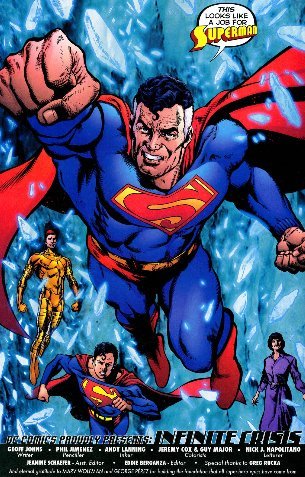 Twenty Years ago DC comics did the unthinkable- They killed off more than half of their universe and completely rebooted their continuity. "Crisis on Infinite Earths" was the crossover that industries have tried and failed to copy ever since. The series was earth shattering; literal. "Crisis on infinite earths" restructured comics into what they are today.
DC has tried many time to duplicate the success of the original "Crisis," but they've never really succeeded. Until Now.
Over the last year or more DC has been slowly guiding it's entire "universe" towards a single looming event. With hints scattered throughout the continuity of various books, cryptic messages and odd occurrences, fans have been waiting eagerly for what comes next. And they were not disappointed.
DC once again changed their universe with "Identity Crisis," a book that shed light on several dark truths that had existed in he DC universe, especially among the Justice League. Fans were also shocked by the deaths of a few heroes, including some favorite supporting characters such as Sue Dibney from "Formerly know as the Justice League." "Identity Crisis" ended, but not before DC let fans know that the wave of change was still on it's way.
The company finally let the fans get a taste of what was coming with "Countdown to Infinite Crisis," a 99 Cent book that blew everyone away and converted every comic fan on earth into a Blue Beetle fan. Focusing on Blue Beetle, the book shows Ted unraveling the mystery behind several recent events and end with his shocking death. With several more countdown series spinning directly out of the book, fans were now worked into a frenzy. What was this "Infinite Crisis?" And just how much would change?
With the release of the Infinite crisis Mini series, DC has officially answered that question: EVERYTHING. A direct sequel to "Crisis on Infinite Earths," DC heralds the new age of comics with the most courageous and inventive event in comic history. "Infinite Crisis," featuring the return of the golden age Superman along with a few friends, several hero deaths and amazing art and writing is comic gold. I warn you, don't pick this up unless you are ready to become addicted. DC is back, and if "Infinite Crisis" is any indication, the future of comics is in their hands.
Sunday, April 02, 2006
Me and the wacky title of this page
 As I may have mentioned above, my name is Mike Cherniske- yes, I'm the one with the dark hair. The beautiful red head in my arms is my wife, Lanae. Yes, I know, how does a fat ugly short guy get such a hot wife? Well, I can't actually say. Not because I don't know, but because I'm currently working to patent the formula. If all goes well you may see it in stores by Christmas.
If you're wondering if I'm serious or not, I'll let you figure that one out on your own.
Now, you're probably wondering about this crazy title. Truth is, I thought it'd be funny. Also, it seems to be the best description of what I plan on talking about on this page. While I'll probably focus on Movies, Comics, and the reasons why people tick me off, I have no mission statement, no divine purpose to guide my writings. And so, after you've read one of my posts, I expect that you'll find yourself asking "And what does that have to do with the price of eggs in china?" Call it my contribution to the world.